Friday, June 11, 2010

6 Safe Exercises During Pregnancy


Starting an exercise program during the hustle and bustle of life can be intimidating alone, try adding in a pregnancy! Even thought this can seem daunting, keep in mind you can help control how you feel during and after your pregnancy by staying active and eating healthy. If you exercise during your pregnancy it will be much easier to lose the pregnancy weight after.


Here are some safe exercises you can participate in:

  • Swimming
  • Yoga
  • Stationary Bicycle
  • Walking
  • Jogging
  • Stair Climber

While exercising during your pregnancy here are some things to avoid:

  • overheating
  • high impact
  • tight or restricting clothing
  • any risk of falling (horseback riding, skiing etc.)
  • exercising while lying on your back-weight bearing exercises that take the weights over your body (bench press, shoulder press etc.)
  • dehydration

*talk to your doctor before starting an exercise plan

Tuesday, June 08, 2010

5 Common Gym Mistakes


1. Eating the wrong foods before and after

Become familiar with the Glycemic Index. 30mins before and within 30mins after weight training consume high glycemic index foods. 30mins before cardio consume low glycemic index foods, and within 30mins after consume high glycemic index foods.

2. Skipping Warm-up and Cool-Down
Both are important to a safe and effecient work out. Include stretching in both!

3. Poor Technique
Make sure you have someone show you the proper way to use weights, wouldn't want to injure yourself. Be aware of your breathing, exhaling during the most difficult part of weight lifting.

4. Skipping Muscles
Many times we concentrate mainly on the muscles we can see in the front of our body, and forget about the muscles in the back. It is important to keep everything in balance by training both sides of our bodies. It is also important to work all the muscles in our body, not just the ones we want to look nice!

5. Ignoring Heart Rate
Keeping track of your heart rate while exercising is a great way to see exactly how hard your body is working. When you are trying to lose fat, you want to participate in cardiovascular exercise for more than 40mins keeping your heart rate within your fat burning range (being able to have a conversation is a good test).

Monday, May 17, 2010

Increase your Protein to Increase your Energy - 5 Ideas!

I attended a Personal Training Conference a few months ago. While at this conference a nutritionist gave a presentation on protein intake. The take home message of her whole presentation was that eating protein 3 times a day (breakfast, lunch, and dinner) is not enough protein. Not only is it not enough protein, but by increasing your protein intake throughout the day, it will also help to increase your energy levels! Here are some tips to increase your protein intake:

1.) MRM Whey Protein Powder- 100% All Natural, No artificial sweeteners or flavors. Not all whey protein powders are created equal, as women we don't want all the extra crap that men use to bulk up, this powder is the answer. With 18g of protein and only 87kcals and less than 1g of natural occurring sugar per serving this stuff is awesome! Try mixing it with milk or oatmeal in the morning, or keep a pre-portioned baggy in your car for mixing with fruit juice for a snack.

2.) Soy Milk- Silk Light Original Soy Milk has 6g of protein, 70kcals, and 6g sugar per serving. Drink a glass in between breakfast and lunch for a punch of protein.

3.) Edamame- also known as soy beans (1/2 C = 11g protein). You can buy these at Trader Joe's or Costco in the frozen veggies section. Try eating these with a little soy sauce, and pop them out of the shells into your mouth. Or prepare them ahead of time by removing them from the shells and mixing them with some corn and tomatoes with a little Italian dressing for a protein packed salad.

4.) Cottage cheese- (1C = 28g of protein) Try mixing some chopped green peppper, scallions, tomato, salt, pepper and lemon zest into it, eat by itself or dip your favorite veggies in it!

5.) Canned Tuna- Stick it in a whole wheat tortilla with hummus and your favorite veggies to get 39.3g of protein per cup!

Sunday, March 14, 2010

A Look at High-Fructose Corn Syrup and American Obesity

We have all heard at one time or another that High Fructose Corn Syrup (HFCS) is making Americans obese; so I decided to take a closer look at the science to see if there is anything to back this up, this is what I discovered.

HFCS is cornstarch that has been highly processed and changed from glucose to fructose, and this new compound is mixed with glucose. This change makes a compound that is very similar to sucrose (table sugar) being 55% fructose 45% glucose (1).

HFCS and sucrose are obviously very similar, and because of this they are also metabolized very similarly (1). According to the American Journal of Clinical Nutrition (1) "Melanson, Stanhope, and Have presented metabolic data from well-designed clinical trials to determine whether the metabolic effects of HFCS were different from those of sucrose. Both researchers reported that HFCS and sucrose study groups had similar blood glucose concentrations and similar insulin responses. Hunger ratings and leptin and ghrelin levels were also similar between the HFCS and sucrose groups."

In other words, they conducted a clinical trial and discovered that HFCS did not effect blood glucose and insulin levels any differently than sucrose. Not only that, but they dispelled the myth that people who consume HFCS have higher hunger levels than those who do not.

So, is HFCS the cause of Americans becoming obese, no.

Does consuming high amounts of HFCS make you obese, yes, but so does consuming high amounts of sucrose.

Do I condone HFCS just because it is not the cause of American obesity, not necessarily. HFCS is still highly processed, and quickly making its way into the majority of our food products, which in turn, adds more calories and contributes to our country's weight epidemic.

Conclusion, in the words of Michael Pollan (author of the Omnivore's Dilemma) "Eat food. Not too much. Mostly plants." Meaning, eat whole (unprocessed) foods: vegetables, fruits, nuts, meat, fish, whole grains. Eat your food in moderation, HFCS shouldn't be in everything or even 50% of everything you eat. Eat plants, which are a great source of vitamins, minerals, antioxidants, fiber, water etc., and a low source of saturated fats, sodium, sugar etc.

References

1 American Journal of Clinical Nutrition (http://www.ajcn.org/cgi/content/full/88/6/1715S?ijkey=nTQQkJ3uBgJdg&keytype=ref&siteid=ajcn)
Friday, March 12, 2010

How to Survive in an Earthquake


EXTRACT FROM DOUG COPP'S ARTICLE ON THE 'TRIANGLE OF LIFE'

"My name is Doug Copp. I am the Rescue Chief and Disaster Manager of the American Rescue Team International (ARTI), the world's most experienced rescue team. The information in this article will save lives in an earthquake.

I have crawled inside 875 collapsed buildings, worked with rescue teams from 60 countries, founded rescue teams in several countries, and I am a member of many rescue teams from many countries.

I was the United Nations expert in Disaster Mitigation for two years. I have worked at every major disaster in the world since 1985, except for simultaneous disasters.

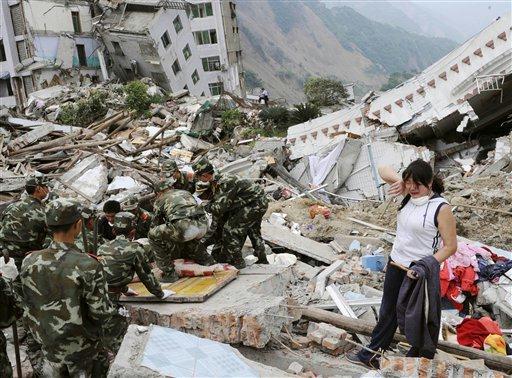
The first building I ever crawled inside of was a school in Mexico City during the 1985 earthquake. Every child was under its desk. Every child was crushed to the thickness of their bones. They could have survived by lying down next to their desks in the aisles. It was obscene, unnecessary and I wondered why the children were not in the aisles. I didn't at the time know that the children were told to hide under something. I am amazed that even today schools are still using the "Duck and Cover" instructions- telling the children to squat under their desks with their heads bowed and covered with their hands. This was the technique used in the Mexico City school.

Simply stated, when buildings collapse, the weight of the ceilings falling upon the objects or furniture inside crushes these objects, leaving a space or void next to them. This space is what I call the 'triangle of life'. The larger the object, the stronger, the less it will compact. The less the object compacts, the larger the void, the greater the probability that the person who is using this void for safety will not be injured. The next time you watch collapsed buildings, on television, count the 'triangles' you see formed. They are everywhere. It is the most common shape, you will see, in a collapsed building.

TIPS FOR EARTHQUAKE SAFETY

1) Almost everyone who simply 'ducks and covers' when buildings collapse ARE CRUSHED TO DEATH. People who get under objects, like desks or cars, are crushed.

2) Cats, dogs and babies often naturally curl up in the fetal position. You should too in an earthquake. It is a natural safety/survival instinct. That position helps you survive in a smaller void. Get next to an object, next to a sofa, next to a large bulky object that will compress slightly but leave a void next to it.

3) Wooden buildings are the safest type of construction to be in during an earthquake. Wood is flexible le and moves with the force of the earthquake. If the wooden building does collapse, large survival voids are created. Also, the wooden building has less concentrated, crushing weight. Brick buildings will break into individual bricks. Bricks will cause many injuries but less squashed bodies than concrete slabs. Concrete slab buildings are the most dangerous during an earthquake.

4) If you are in bed during the night and an earthquake occurs, simply roll off the bed. A safe void will exist around the bed. Hotels can achieve a much greater survival rate in earthquakes, simply by posting a sign on the back of the door of every room telling occupants to lie down on the floor, next to the bottom of the bed during an earthquake.

5) If an earthquake happens and you cannot easily escape by getting out the door or window, then lie down and curl up in the fetal position next to a sofa, or large chair.

6) Almost everyone who gets under a doorway when buildings collapse is killed. How? If you stand under a doorway and the doorjamb falls forward or backward you will be crushed by the ceiling above. If the door jam falls sideways you will be cut in half by the doorway. In either case, you will be killed!

7) Never go to the stairs. The stairs have a different 'moment of frequency (they swing separately from the main part of the building). The stairs and remainder of the building continuously bump into each other until structural failure of the stairs takes place. The people who get on stairs before they fail are chopped up by the stair treads - horribly mutilated. Even if the building doesn't collapse, stay away from the stairs. The stairs are a likely part of the building to be damaged. Even if the stairs are not collapsed by the earthquake, they may collapse later when overloaded by fleeing people. They should always be checked for safety, even when the rest of the building is not damaged.


8) Get Near the Outer Walls Of Buildings Or Outside Of Them If Possible - It is much better to be near the outside of the building rather than the interior. The farther inside you are from the outside perimeter of the building the greater the probability that your escape route will be blocked.

9) People inside of their vehicles are crushed when the road above falls in an earthquake and crushes their vehicles; which is exactly what happened with the slabs between the decks of the Nimitz Freeway. The victims of the San Francisco earthquake all stayed inside of their vehicles. They were all killed. They could have easily survived by getting out and lying in the fetal position next to their vehicles. Everyone killed would have survived if they had been able to get out of their cars and sit or lie next to them. All the crushed cars had voids 3 feet high next to them, except for the cars that had columns fall directly across them.

10) I discovered, while crawling inside of collapsed newspaper offices and other offices with a lot of paper, that paper does not compact. Large voids are found surrounding stacks of paper.

In 1996 we made a film, which proved my survival methodology to be correct. The Turkish Federal Government, City of Istanbul , University of Istanbul Case Productions and ARTI cooperated to film this practical, scientific test. We collapsed a school and a home with 20 mannequins inside. Ten mannequins did 'duck and cover,' and ten mannequins I used in my 'triangle of life' survival method. After the simulated earthquake collapse we crawled through the rubble and entered the building to film and document the results.

The film, in which I practiced my survival techniques under directly observable, scientific conditions, relevant to building collapse, showed there would have been zero percent survival for those doing duck and cover.

There would likely have been 100 percent survivability for people using my method of the 'triangle of life.' This film has been seen by millions of viewers on television in
Turkey and the rest of Europe, and it was seen in the USA , Canada and Latin America on the TV program Real TV.

Spread the word and save someone's life... The entire world is experiencing natural calamities so be prepared!"

Tuesday, March 09, 2010

3 Reasons to Skip the Restaurant and Eat at Home

We all get too busy and lazy to cook and eat at home everyday, but here are some reasons why we should try to prepare our own meals more often than picking something up elsewhere:

1. Cost: The average person will save about $75 per week just by preparing their own meals at home. Imagine what you could do with an extra $337 a month!

2. Hidden Calories: More often than not even the healthiest looking item on the menu is packing way too many calories for one meal.

3. Saturated Fat Overload: As someone who used to cook in a restaurant kitchen I can tell you, Chefs don't care how many calories each meal has, it is all about flavor. I worked in an Italian restaurant and there was not one dish that left the kitchen without mounds of butter in it, yes I said MOUNDS! Not only that, but when dining in a restaurant you are more likely to finish the entire meal, including the huge saturated fat steak you ordered.

Monday, December 07, 2009

Seattle: Dangers of Vitamin D Deficiency

Seattle, WA is a beautiful place to live, and for those of us that live here the overcast days and periodic rain is nothing new to our everyday routine. We have come to embrace the cloudiness and accept that in the winter most activities will take place in-doors. With this shift into our warm and dry homes and automobiles, along with the cloudy skies, we greatly reduce our exposure to the sun. While dermatologists everywhere are celebrating this, our general practitioners and cringing when they see our blood tests that inevitably say we are dangerously low in vitamin D.

The term "vitamin D" refers to several different forms of this vitamin. Two forms are important in humans: ergocalciferol (vitamin D2) and cholecalciferol (vitamin D3). Vitamin D2 is synthesized by plants, and Vitamin D3 is synthesized by humans in the skin when it is exposed to ultraviolet-B (UVB) rays from sunlight. Foods may be fortified with vitamin D2 or D3.

Vitamin D is essential for promoting calcium absorption in the gut and maintaining adequate serum calcium and phosphate concentrations to enable normal mineralization of bone and prevent hypocalcemic tetany. It is also needed for bone growth and bone remodeling by osteoblasts and osteoclasts. Without sufficient vitamin D, bones can become thin, brittle, or misshapen. Vitamin D sufficiency prevents rickets in children and osteomalacia in adults. Together with calcium, vitamin D also helps protect older adults from osteoporosis.

What does all that mean? Basically vitamin D is a very important vitamin to have circulating around in our systems. Without vitamin D we are unable to absorb calcium, which causes our bones to become brittle. This is why milk is now fortified with vitamin D, to promote the absorption of the calcium in milk!

Now, all this talk about not getting enough vitamin D makes us want to run to the drug store and buy multivitamins, right? Well, there are a few things we need to know first. Vitamin D is a fat-soluble vitamin, meaning it is possible to have too much, but recently research has been challenging the current tolerable upper limit (UL). Due to this, I am not going to state the amount you should be getting, but here is a link to one of the articles on it, feel free to do a little research yourself [Research Link]. I also encourage you to ask your general practitioner their advice on the topic, but either way put some thought into your vitamin D intake!


References
http://dietary-supplements.info.nih.gov/factsheets/vitamind.asp
http://www.mayoclinic.com/health/vitamin-d/NS_patient-vitamind